Groovy Stars Star Chart
The story behind Groovy Stars
I'm an amateur astronomer, not a software developer. Groovy Stars started as a simple question I couldn't stop asking on cloudy nights: could I actually build the observing app I kept wishing existed?
Like a lot of people in this hobby, I'd used the big planetarium and planning programs for years. They're wonderful — but none of them worked quite the way I did. I'd reach for one tool for the star chart, another for planning the night, a third for my equipment, and yet another for framing a target. I kept thinking the same thing: I just want one place that fits the way I actually observe.
So I started experimenting. No grand plan, no intention to release anything — just me, curious whether I could make a chart that showed the sky the way I liked to see it. One feature led to another. A star field became a deep-sky atlas. The atlas grew a planner. The planner needed my telescopes and eyepieces, so I added equipment. Then it needed to know what was up tonight, where the Moon was, and when the sky was truly dark. Before long it could point my telescope, frame my camera, and tell me which comets were actually worth chasing.
At some point it stopped being an experiment and became the tool I reach for on every clear night. I checked its math against real eclipses and occultations, so I could trust what it told me. And the more I used it, the more I thought: if it fits me, maybe it fits other people who observe the way I do.
That's why Groovy Stars is free. I have a day job; this was never about making money. It's a hobby project that got out of hand in the best possible way, and I'd rather put it in the hands of fellow amateurs than lock it behind a price. If it helps you plan a better night — or just enjoy the sky a little more — that's the whole point.
Features
Groovy Stars is a modern, native planetarium and observing planner for the Mac — a complete tool for planning a night under the stars, framing your next astrophoto, and pointing your telescope, all in one app.
A REAL SKY
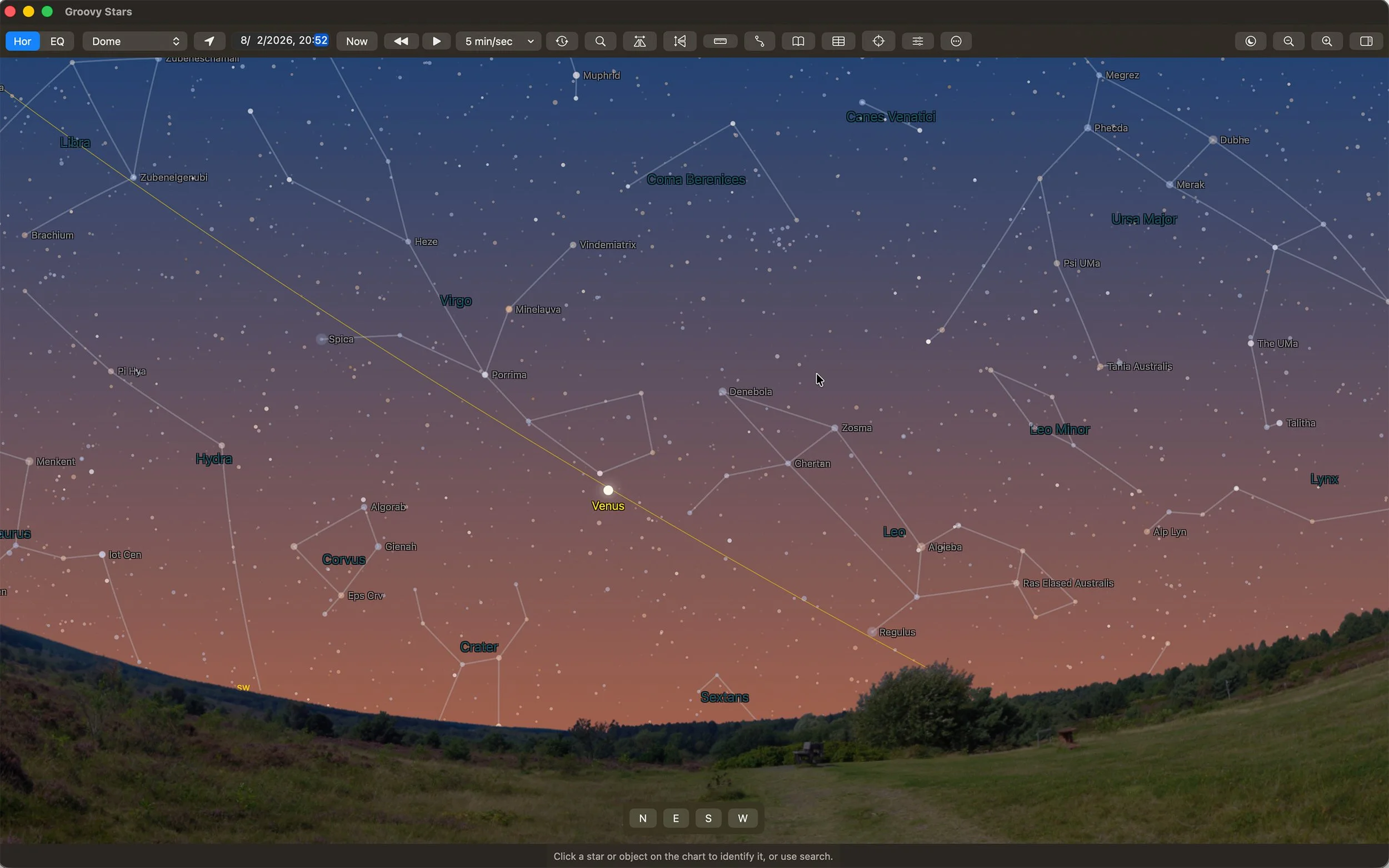
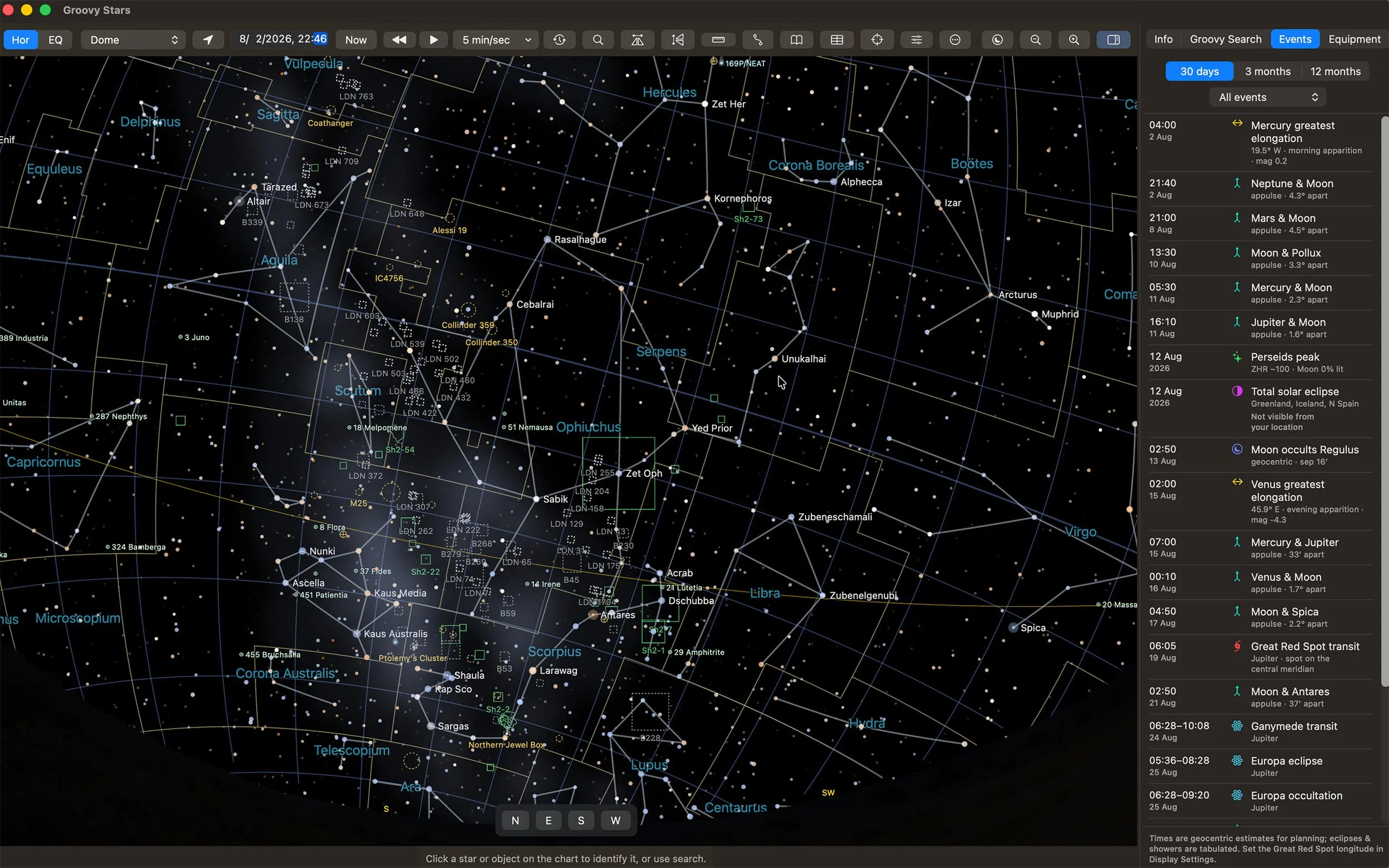
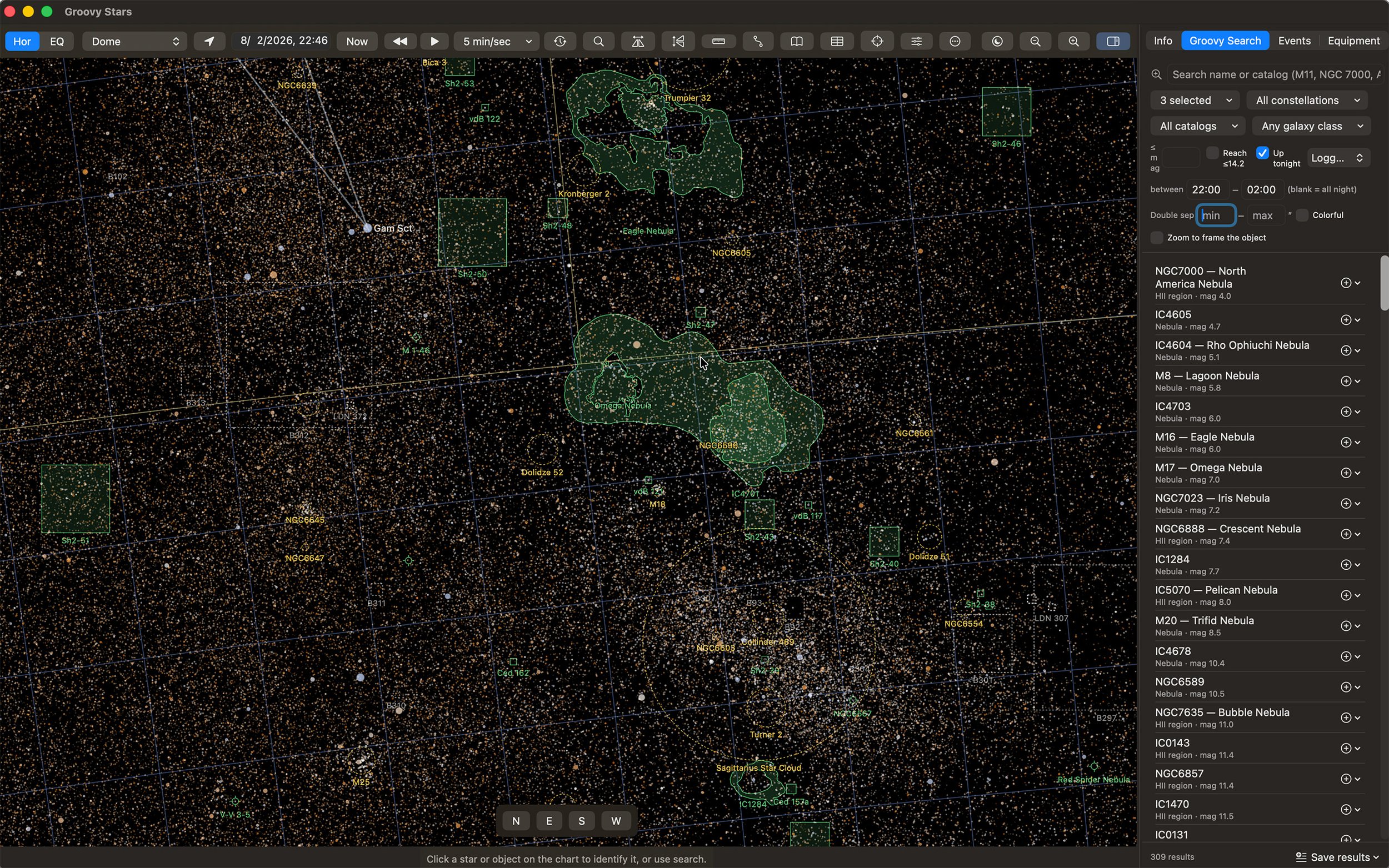
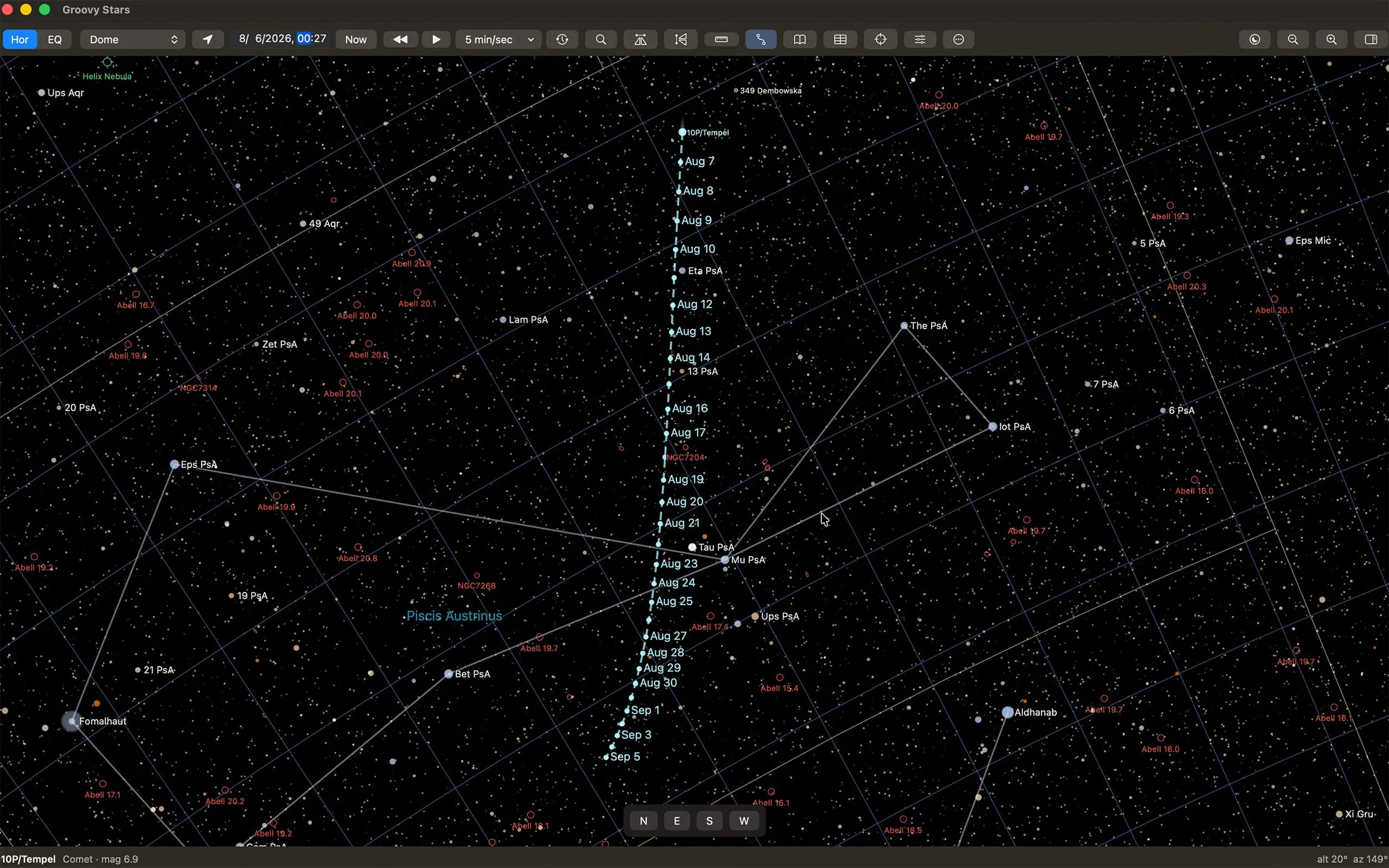
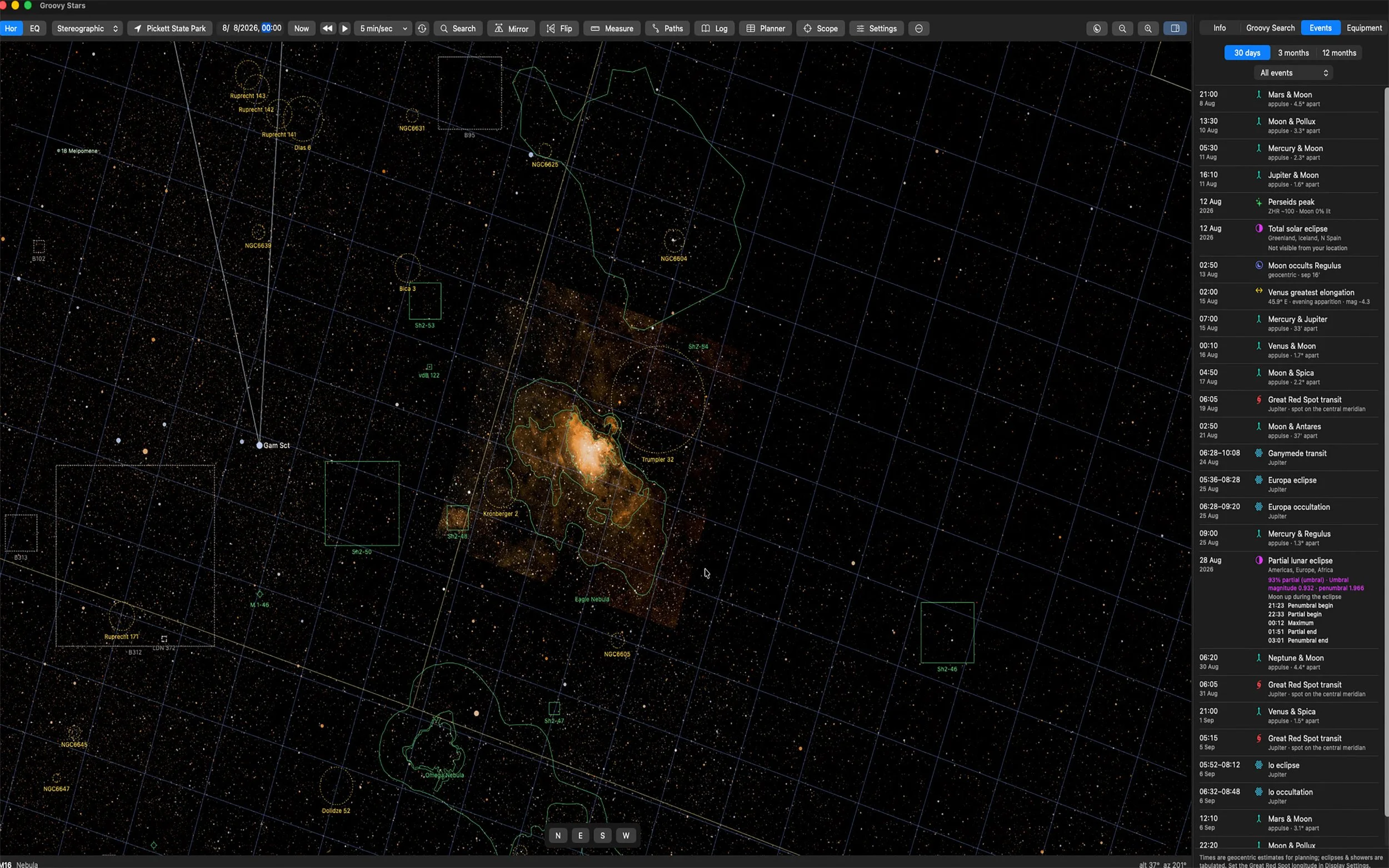
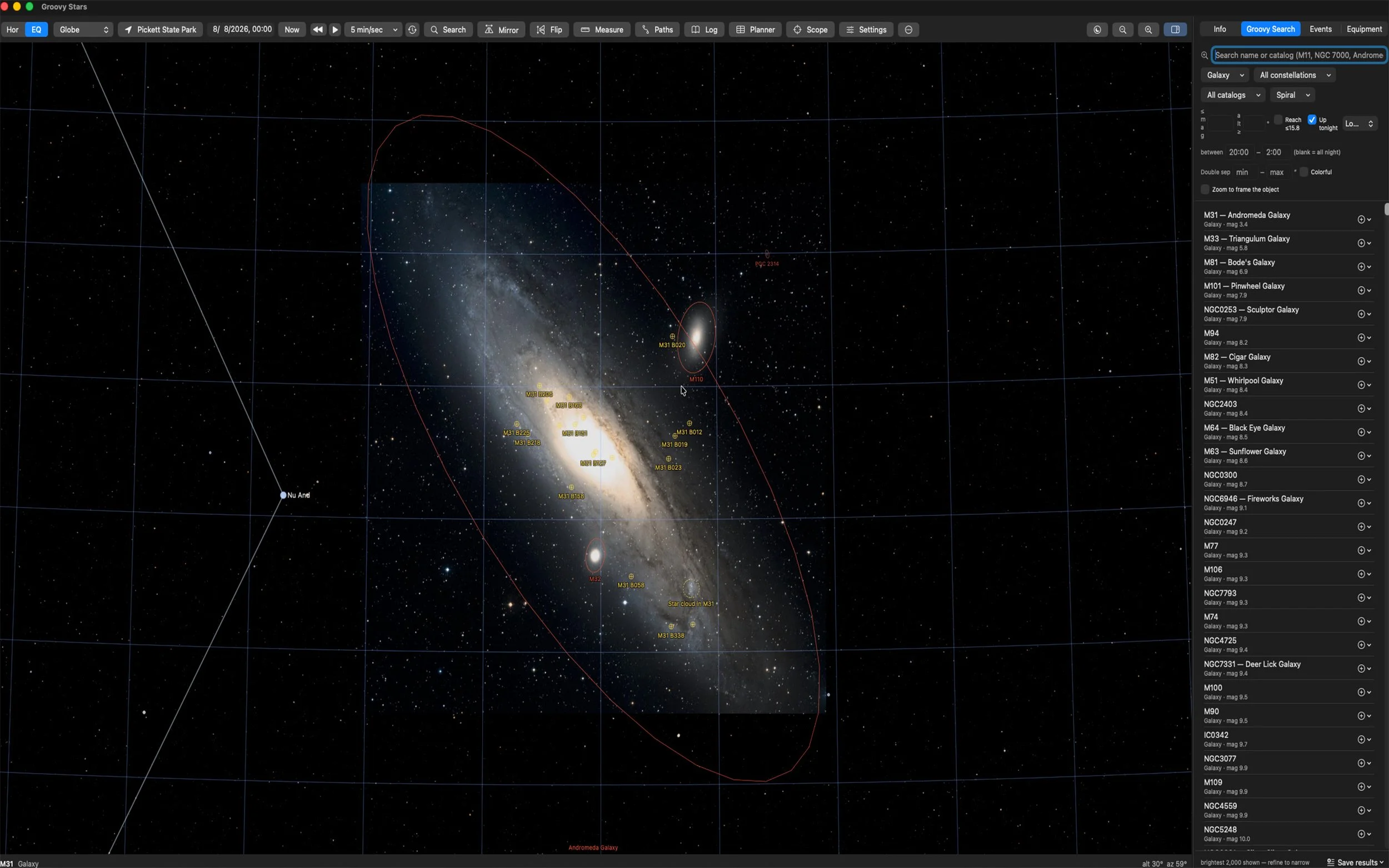
Explore a deep sky drawn from Gaia DR3 — over 36 million stars — with the full deep-sky catalogs: Messier, Caldwell, the complete NGC and IC, Sharpless emission nebulae, Barnard and Lynds dark nebulae, planetary nebulae, clusters, galaxies, quasars, and more — many drawn with their true outlines. Switch between a first-person horizon view and the equatorial atlas, dim the sky with realistic atmosphere, light pollution, and moonlight, and orient yourself with the Milky Way and a custom horizon.
PRECISE TO THE ARCSECOND
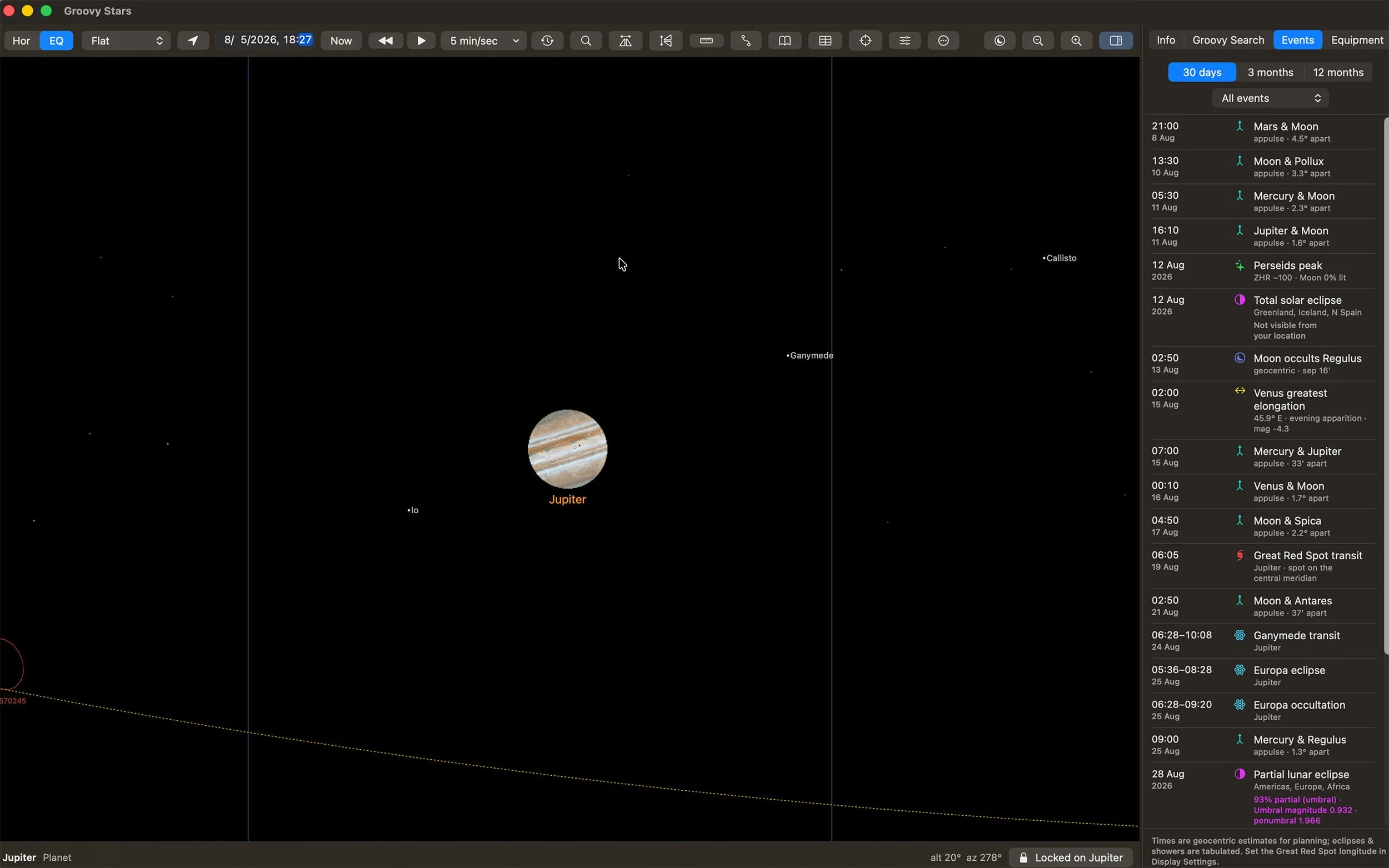
Positions come from modern theories — VSOP87 for the planets and the complete Meeus lunar theory for the Moon, with topocentric parallax — validated against JPL Horizons. Eclipses, transits, and occultations line up with the real sky from your exact site.
FIND ANYTHING
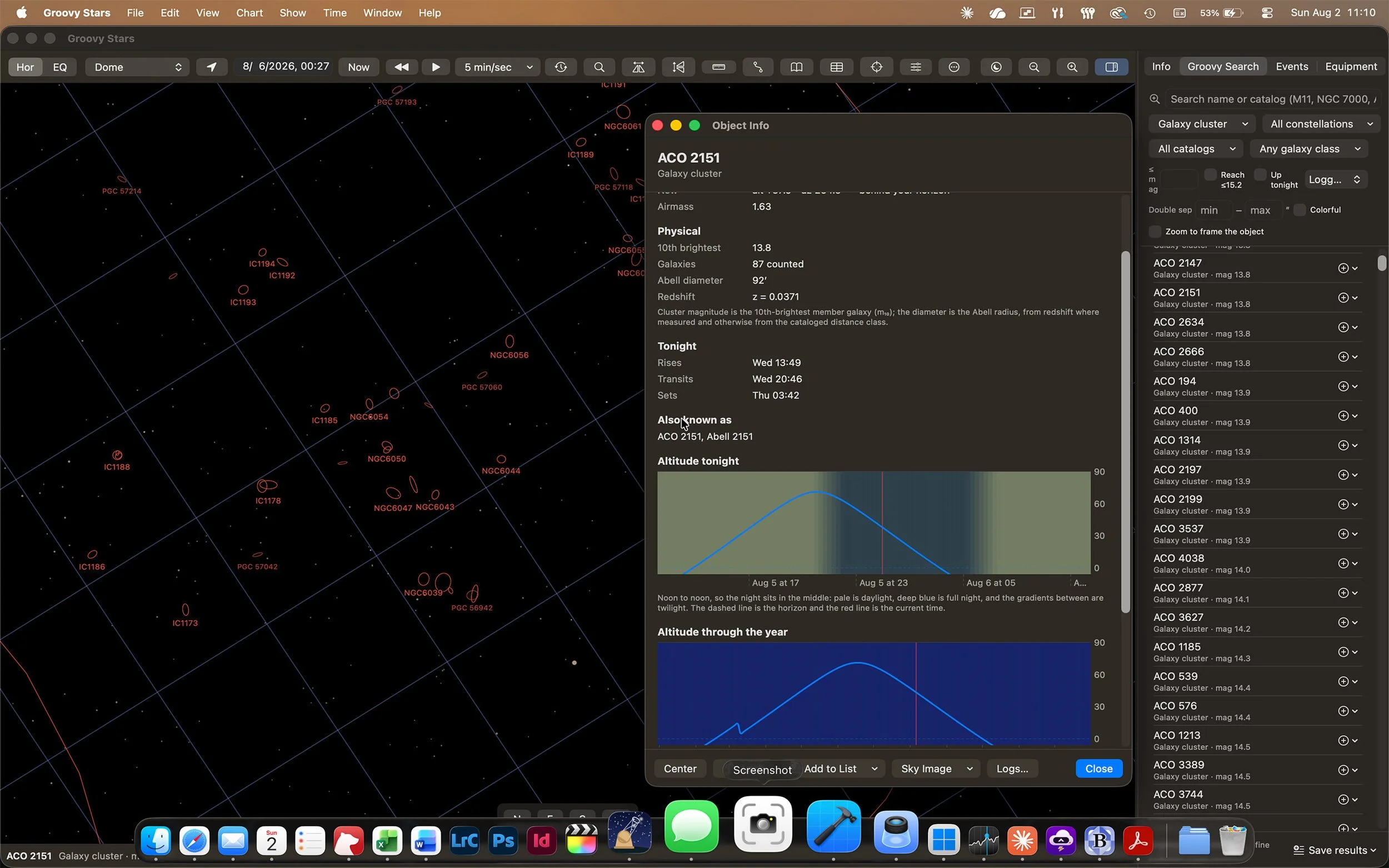
Groovy Search filters the entire sky by type, constellation, catalog, magnitude, size, and what's actually up tonight from your location. Click any object for its details, a rise/set table, and a real sky image.
PLAN YOUR NIGHT
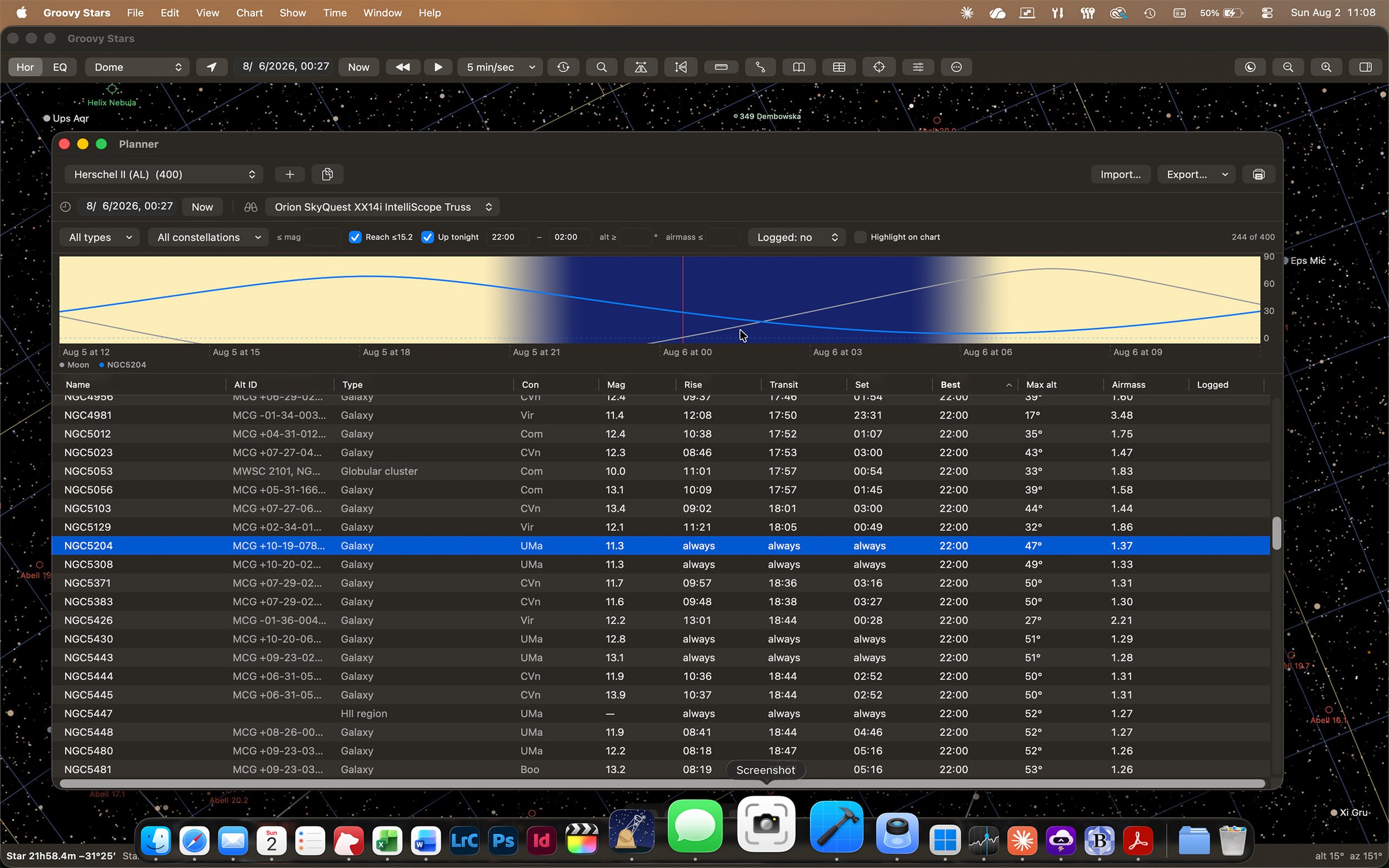
Turn any list into a sortable Planner with a night bar showing darkness, twilight, and moonlight. Work through the Messier, Herschel 400, and Astronomical League programs, or build your own. Keep an observing log with sketches and sessions. The Dark Nights planner finds the moonless nights worth shooting, weeks ahead.
BUILT FOR IMAGERS
Score targets for tonight by altitude, Moon separation, and how well they fit your camera. Draw your camera or smart-telescope field right on the chart — including alt-az field rotation, so you can see how a target will sit through the night. Frame it, then slew your mount to it.
CONTROL YOUR TELESCOPE
Point a Go-To or push-to mount over ASCOM Alpaca, LX200/WiFi, or INDI. Select a target, confirm, and slew, with a built-in Sun-safety block.
ALWAYS CURRENT
Update comet, asteroid, and dwarf-planet elements straight from the Minor Planet Center, Lowell Observatory, and JPL. Comet brightness can be fit to real visual observations for magnitudes closer to what you'll actually see. Recent supernovae and today's sunspots plot in place.
YOUR EQUIPMENT
Add your telescopes, eyepieces, and cameras from a large built-in database (or your own), apply a focal reducer, and see accurate fields of view — Telrad rings, eyepiece circles, and camera frames — on the chart.
MADE FOR THE EYEPIECE
Red night mode protects your dark adaptation. Print clean, dark-on-white charts, checklists, and logs for the field.
Groovy Stars is free — made by an amateur astronomer, for amateur astronomers. Clear skies.